Furikake 101
Japanese Furikake: The Complete Guide
What is furikake? Learn its meaning, taste, sprinkle-on and mix-in types, how it differs from ochazuke and shichimi, and how to read a Japanese packet.
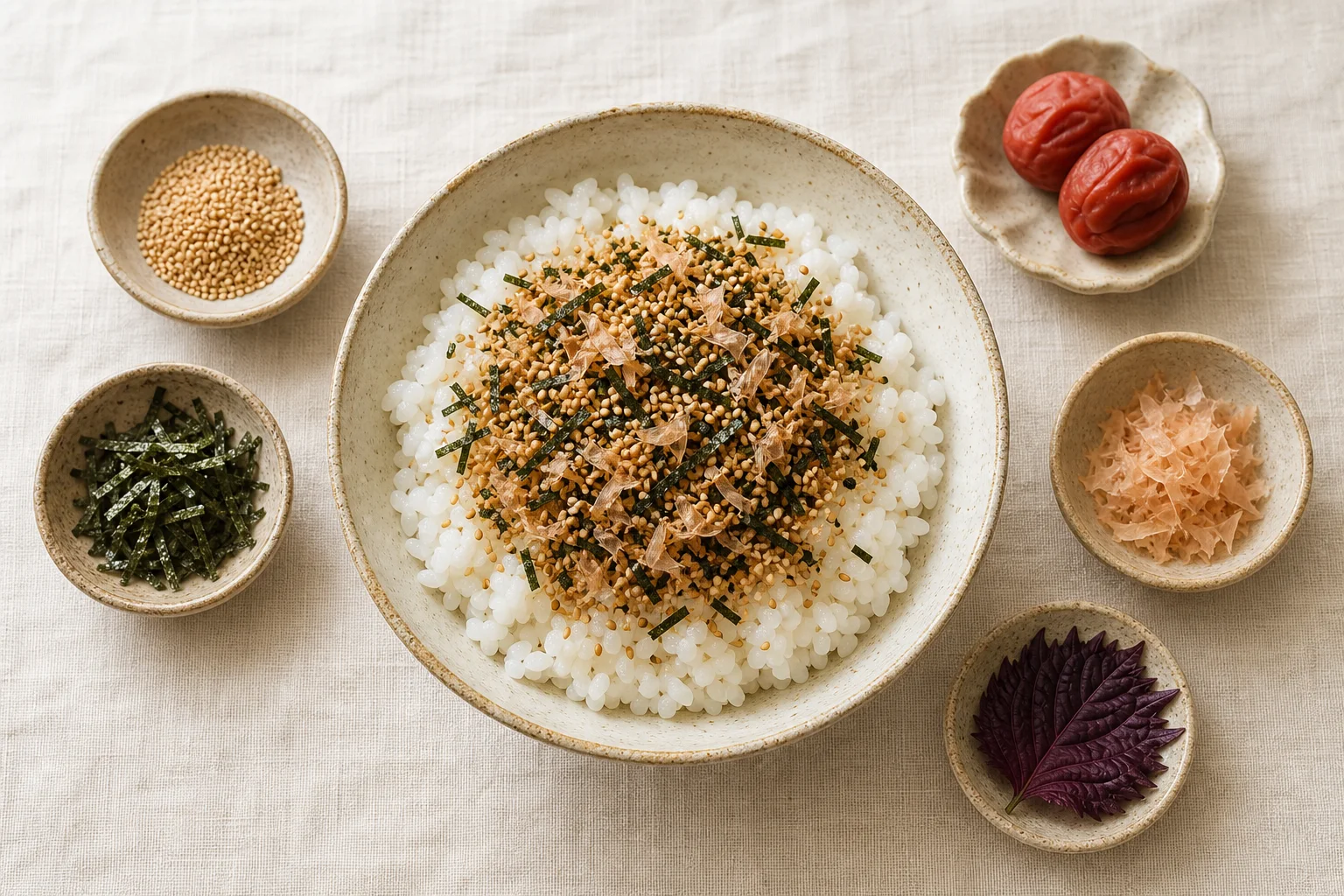
What is furikake?
Furikake (ふりかけ) is a Japanese seasoning made for cooked rice. The standard use is to sprinkle it on rice, although mix-in products also exist. There is no fixed recipe: fish, seaweed, sesame, egg, shiso, vegetables, meat, and other seasonings can all appear, so the exact packet—not the category name—determines its ingredients and taste.
What does furikake mean?
The name furikake literally means “sprinkle over” in Japanese. Merriam-Webster traces it to furikakeru, “to sprinkle over”; Kikkoman uses the same literal translation for the rice seasoning. The term describes how it is used, not a fixed recipe. Some products are sprinkled over cooked rice, while designated mix-in furikake is stirred through it.
How do you pronounce furikake?
For a Japanese-style reading, divide ふりかけ as fu-ri-ka-ke, with four short units. The Japan Foundation's learner word list marks the word with no pitch-accent fall, and its official lesson 12-3 word-list audio provides an example. Cambridge separately records the English pronunciations UK /ˌfʊr.ɪˈkɑː.ki/ and US /ˌfʊr.əˈkɑː.keɪ/. Those entries document English usage, not one pronunciation shared by every Japanese speaker and region.
Where did furikake come from?
Commercial furikake has more than one origin story. Kikkoman places the first market introductions of early furikake-style products in Japan's Taishō era (1912–1926).Kumamoto City describes Gohan no Tomo as a Taishō-era product with more than a century of local history, while Hiroshima Prefecturepresents Ryokō no Tomo as an early portable fish-based seasoning. Those local product histories do not by themselves establish one uncontested inventor.
| Period | What the source establishes | Evidence limit |
|---|---|---|
| Taishō era (1912–1926) | Kikkoman's food-culture publication places early commercial introductions in this period. | It does not name one inventor or settle which product came first. |
| 1994 | The National Furikake Association recognized Futaba's Gohan no Tomo as the origin product. | This former decision is historical context, not the association's current conclusion. |
| June 24, 2022 | The Japan Food Journal reported that the association withdrew the 1994 recognition and opened a new review. | The withdrawal did not disprove Gohan no Tomo's own product history. |
| 2023–2024 | Tanaka Foods and a later Hiroshima Prefecture account say the re-examination found that the oldest documentary evidence reviewed concerned Ryokō no Tomo. | This is evidence about the records reviewed—not proof of a single undisputed act of invention. |
That distinction matters because many English summaries still repeat the withdrawn 1994 decision as if nothing changed. The safest current answer to “who invented furikake?” is that modern commercial furikake developed through several early product histories, while the association's assessment of the oldest documentary evidence has changed. We name the source and its limit instead of turning a record dispute into a clean legend.
What is furikake made of?
Ingredients vary widely by flavor and brand, but dried fish (usually katsuobushi, dried bonito), seaweed (nori), sesame, egg, and salt are the most common base ingredients. Because fish is such a common base, allergen profiles vary a lot from product to product — we verify each one individually rather than generalizing.
Across the 28 products we've checked as of 2026-07-13: 20 list fish ingredients (71%), 18 list dairy (64%), and 15 list egg (54%). Only 2 list no animal-derived ingredient at all. See the full breakdown on ourdietary restriction hub.
Another 27 of 28 labels use the Japanese group name 調味料(アミノ酸) or 調味料(アミノ酸等). That wording identifies a seasoning-additive group, not an exact substance. Our furikake and MSG label guide explains why it cannot be automatically translated as MSG.
What are the main types of furikake?
Kikkoman's food-culture overviewclassifies furikake on two separate axes: how it is used and how much moisture it contains. These are format distinctions, not flavor rankings.
By use: sprinkle-on or mix-in
Sprinkle-on furikake is dusted over cooked rice. Mix-in furikakeis stirred through cooked rice and is commonly used for onigiri that will be eaten after the rice cools. Follow the preparation wording on the exact packet rather than deciding from the visible ingredients alone.
By moisture: dry or soft/moist
Dry furikake is the familiar shelf-stable flake or granule format.Soft or moist furikake contains more moisture; Kikkoman says these varieties typically require refrigeration after opening. “Typically” is not a product-specific storage instruction, so read the exact package after purchase.
Flavor categories in our database
Format does not determine flavor. The current 28-product dataset includes categories such as the following; each link shows the products actually recorded under that label.
- Nori & Egg (Noritama): see every nori & egg (noritama) product on the flavors page.
- Bonito (Katsuo): see every bonito (katsuo) product on the flavors page.
- Salmon (Sake): see every salmon (sake) product on the flavors page.
- Shiso Leaf: see every shiso leaf product on the flavors page.
- Plum (Ume): see every plum (ume) product on the flavors page.
- Wasabi: see every wasabi product on the flavors page.
Browse all flavor categories on the flavors index.
What does furikake taste like?
Furikake does not have one fixed taste. Kikkoman describes the category as savory, but an exact packet may lean toward seaweed and egg, fish, salty-sour red shiso, or sharp wasabi. We have not taste-tested these products. The examples below are limited to current official labels and maker descriptions, not first-hand tasting notes.
- Marumiya's current ingredient panelfor Noritama combines egg and nori; it also lists sesame, mackerel flakes, and matcha.
- Yukari takes a different route:Mishima's label and product descriptioncenter salted red shiso and plum vinegar, while the maker highlights the shiso's natural color and aroma. The reviewed label lists no fish ingredient.
- Nagatanien describesOtona no Furikake Wasabiwith the aroma and pungency of freshly grated wasabi, plus bonito and crisp nori.
Does furikake taste fishy?
Sometimes, but a fish ingredient does not prove how strong the finished seasoning will taste. Across the 28 current product records, 20 (71%) list fish ingredients. Marumiya's reviewed Soft Furikake Sake label lists salmon and salmon extract. That establishes the formula, not how strong it will taste. Yukari's reviewed label lists no fish ingredient. Formula and intensity vary by packet, and we did not taste-test either product. If avoiding fish matters, use the label-screened no-fish guide and recheck the physical package.
Furikake vs ochazuke, gomashio, and shichimi
For the standard use, furikake goes on cooked rice without added liquid; instant ochazuke is served over rice with the liquid named in the package directions. Look forふりかけ on furikake and お茶づけ, お茶漬け, or 茶づけ on ochazuke. If the front is unclear, read the preparation panel before opening the packet.
On a narrow screen, swipe the table to compare all four packet types.
| Category | Words to look for | Add liquid? | Standard use and limit |
|---|---|---|---|
| Furikake | ふりかけ | No for the standard use | Sprinkle on or mix into cooked rice. Soft and mix-in types exist, so follow the exact product. |
| Ochazuke mix | お茶づけ/お茶漬け/茶づけ | Yes—use the amount and liquid on the directions | Put it over rice, then add the directed liquid. Nagatanien says hot water, not extra tea, for its standard mix because tea is already included; other products can differ. |
| Gomashio | ごましお/ごま塩/胡麻塩 | No | A sesame-and-salt direction commonly sprinkled on rice. A retail blend can contain more than two ingredients, so the name is not a full label. |
| Shichimi | 七味/七味唐辛子 | No | A chili-led mixed spice used on foods such as noodles, soups, meat, and fish. Its ingredients and heat vary by maker. |
Is furikake the same as togarashi or shichimi?
No. Kikkoman describes furikake as a rice seasoning that can include fish, seaweed, sesame, egg, or vegetables. Togarashi means chili pepper: ichimi is a single red-chili seasoning, while shichimi is a chili-led blend whose ingredients vary by maker. A spicy furikake remains furikake; shared sesame or seaweed does not make shichimi a furikake.
On a Japanese label, look for 一味/一味唐辛子 for ichimi and 七味/七味唐辛子 for shichimi. Some export packaging says NANAMI TOGARASHI: S&B explains that it uses nanami so overseas shoppers do not confuse the similar-sounding shichimi and ichimi. NANAMI is therefore a packaging clue for shichimi in that context, not a separate eighth seasoning category.
A packet category is a shopping shortcut, not an allergy or customs guarantee. Read the directions, ingredient panel, and allergen statement on the product in your hand. Our Japanese label decoder shows where to find each field.
Can I eat furikake on my diet?
Often not without checking first — most furikake contains fish, egg, or dairy. We maintain verified lists for every major restriction: vegan candidates, vegetarian candidates, no-fish furikake, a guide for Muslim travelers, and a gluten & wheat guide. Start at the Can I Eat This? hub for the full picture, including what Japanese ingredient labels do and don't tell you. At the shelf, use the Japanese furikake label decoderto find ingredients, allergens, dates, and storage instructions.
Which furikake should I buy in Japan?
Start with our brand guide by traveler need, see the furikake souvenir shortlist for exact packets, or browse the full product index — all 28 products, verified against official manufacturer labels.
Still deciding whether a packet deserves room in your bag? Compare package value in our suitcase-space guide, or use the complete furikake guide index to plan around shopping, labels, cooking, or product comparisons.
Where can I buy furikake?
Current purchase evidence differs by product and branch. Don Quijote publishes its own-brand furikake catalog, Haneda lists one airport-exclusive set, and KIX Duty Free lists three seasonings; Narita's directory does not prove item-level stock. See our dated where-to-buy guidebefore planning around a specific shop.
How do you use furikake?
The default use is steamed white rice — sprinkled directly over a bowl, or mixed in before shaping onigiri. It's also a bento box staple, and a common everyday seasoning for eggs, tofu, and vegetables. In recent years it's crossed over into non-Japanese dishes too: buttered pasta, popcorn, and avocado toast are common social-media uses, even though none of that is traditional.
Once a packet is open, the printed date is no longer the whole storage answer. See how to read the best-before date and store furikake.
For a specific meal, compare mix-in and sprinkle-on furikake for onigiri or label-backed picks for salmon. If everything bagel seasoning is your reference point, start with our side-by-side seasoning guide.
Sources & methodology
Method: Claims on this page are checked against the named official or primary sources below, using the limitations described in Gohan Guide's verification method.
- Kikkoman — Furikake Rice Seasoning
- Merriam-Webster — Furikake Definition and Word History
- The Japan Foundation — Irodori Elementary 1 Word List
- The Japan Foundation — Irodori Elementary 1 Lesson 12-3 Audio
- Cambridge Dictionary — Furikake Pronunciation in English
- Hiroshima City — The Hiroshima Brand: Ryokou no Tomo
- Kumamoto Official Guide — Gohan no Tomo History
- Japan Food Journal — National Furikake Association Origin Review
- Tanaka Foods — Furikake Origin Re-examination Update
- Hiroshima Prefecture — Ryokou no Tomo Documentary Evidence
- Shichimi.net — Furikake and Ochazuke Products
- Nagatanien — Ochazuke Nori
- Nagatanien — Ochazuke FAQ
- Kikkoman — Sesame Glossary
- S&B Foods Worldwide — Nanami Togarashi
- Marumiya — Noritama
- Mishima Foods — Yukari
- Nagatanien — Otona no Furikake Wasabi
- Marumiya — Soft Furikake Salmon
- Yawataya Isogoro — Ichimi Togarashi
- Yawataya Isogoro — Shichimi Ingredients
- S&B Foods — Why Nanami Togarashi Is Used Overseas