Furikake field guide
10 Furikake Souvenir Picks to Buy in Japan
A label-based shortlist of 10 furikake souvenirs from our current database, with recipient fit, reference prices, ingredients, and sales channels.
If you’re looking for a Japanese food souvenir that does not demand half your suitcase, furikake is a strong candidate: most packets are light, shelf-stable, inexpensive, and useful long after the novelty of the gift has worn off. This shortlist draws 10 products from our database of 28. It is based on official-source records and package practicality—not a taste test or a claim that the first item tastes best. We have not eaten these products. Any flavor language below is limited to the product records. Draft English ingredient translations stay unpublished until separately source-reviewed; linked product pages show the original Japanese label and normalized facts in the meantime.
Before You Buy: Four Checks at the Shelf
Use this sequence before a furikake souvenir goes into your basket. It combines category, package, label, and travel checks; it does not replace the exact packet or your destination authority.
- Find ふりかけ on the front. If the packet says お茶づけ or 七味, it is a neighboring category used differently. Use the packet comparison when the shelf looks interchangeable.
- Match the package to the recipient. Compare the Japanese flavor words and product categories, then choose the format: individually wrapped mini packets are easier to divide, while a resealable pouch suits repeat household use. Those are package choices, not taste rankings.
- Read the exact label. Check both 原材料名 and the allergen wording 一部に…を含む. A category name is not an allergy check; the Japanese label decoder explains the limits.
- Check the trip home. Read 賞味期限 and 保存方法, then check the official rules for the destination. Our storage guide and customs starting point do not create one universal clearance rule.
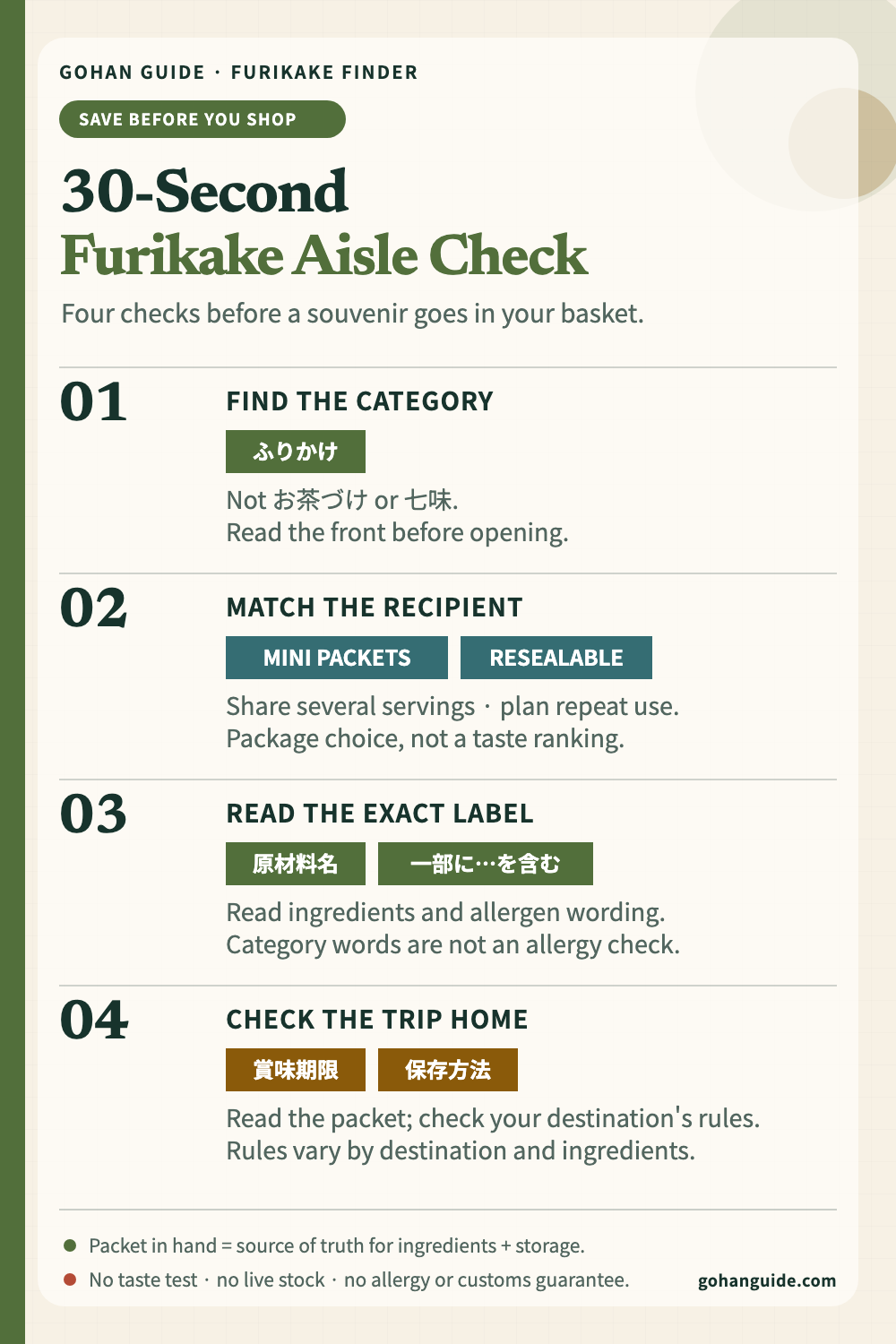
Save the 2:3 card before shopping, then use the physical packet for ingredients, storage, and current packaging.
Pick One in 30 Seconds
On a narrow screen, swipe the table to compare all columns.
| If you are buying for… | Start with | Why it made this list |
|---|---|---|
| A first-time furikake buyer | Noritama | A maker-documented egg-and-nori classic first sold in 1960 |
| Someone who avoids fish ingredients | Yukari | Red-shiso seasoning with no fish ingredient listed |
| A child or Pokémon fan | Pokémon Mini Packs | 20 small packets across four flavors |
| Someone who likes spicy food | Yuzu Kosho Furikake | A citrus-and-chili direction rather than the usual mild blend |
| A household that will use it often | Sarukani Gassen | The largest pack in our database, with a resealable pouch |
“No fish listed” is not the same as vegan certification, allergy safety, or customs clearance. If the recipient has dietary restrictions, use the allergen chart before buying, then use the Japanese label decoder on the physical package.
If the recipient asks specifically about MSG, do not translate 調味料(アミノ酸等) into a definite yes or no. It is a broader Japanese seasoning group name. Our furikake and MSG label guide shows what the wording establishes and when manufacturer confirmation is still needed.
How We Built the Shortlist
We filtered the database using five things a traveller can verify before purchase: whether the product represents a distinct furikake style, whether its maker records a clear product story, how practical the package is as a gift, whether a purchase route is explicitly documented, and whether price and ingredients are sourced. The order below is an editorial reading sequence, not a score or taste ranking. A missing sales channel means we have not verified one from the cited source; it does not mean the product is unavailable. Prices are maker reference prices recorded in the product data, not live shelf prices. Each product link leads to the Japanese label text, source-check date, and official product page used for the record. If you would rather choose a maker before an exact packet, use our 12-brand comparison.
10 Souvenir Picks
Noritama
Noritama (のりたま) is Marumiya’s long-running egg-and-nori furikake, first sold in 1960. The current official ingredient record also lists sesame, dried mackerel flakes, and a matcha-salt mix. The 25g pack has a ¥140 maker reference price, making it a recognizable starting point if the recipient eats its listed ingredients. The cited maker page does not document a store channel or live shelf price. The label lists fish, egg, dairy, and meat among its ingredients.
Yukari
Yukari (ゆかり) is Mishima Foods’ red-shiso seasoning, a different direction from the usual fish-and-seaweed blend. The maker describes it as something to mix into steamed rice, and the 46g pack has a ¥275 maker reference price. Its cited product page does not name a store channel. The label lists no fish, egg, dairy, or meat ingredients, making it one of only two products in our plant-based candidates list—worth a look if you’re shopping for someone avoiding those ingredients, though “candidate” is deliberately a lower bar than certification.
Ryokou no Tomo
Tanaka Foods’ Ryokou no Tomo (旅行の友) means “travel companion.” Its official record describes small fish powder, sesame, nori, and egg and suggests it for rice, rice balls, and bento. The maker reference price is ¥140. Hiroshima City’s official brand page lists grocery, retail, convenience, and drug stores as its main sales channels, but does not promise stock at a particular branch. The label lists fish, egg, dairy, and meat among its ingredients.
Gohan no Tomo
Futaba presents Gohan no Tomo (御飯の友, “rice’s friend”) as a long-running Kumamoto furikake made from whole-ground dried sardines (iriko), with soy sauce, egg, seaweed, nori, and sesame in the record. Choose it for the maker’s regional story rather than a taste claim from us. We verified a maker-direct online product page, but that does not establish that other shops never carry it; we do not have a reference price yet. The label lists fish, egg, and dairy among its ingredients, with no listed meat.
Otona no Furikake, Bonito
Nagatanien’s Otona no Furikake (“adult’s furikake”) bonito flavor has been sold since 1989, pairing bonito flakes with nori in the maker’s description. Each ¥140 reference-price bag comes as individually wrapped packets, so unopened servings remain sealed separately—a useful feature for a souvenir that might sit in a suitcase for a week or two. The cited maker page does not document a product-specific store or online route. The label lists fish among its ingredients, with no listed egg, dairy, or meat.
Pokémon Furikake Mini Packs
Marumiya’s Pokémon-branded assortment contains 20 individually wrapped mini packets across egg, salmon, bonito-flake, and vegetable versions, with calcium listed by the maker. The separate packets are easy to divide between lunch boxes or gift recipients. The pack has a ¥281 maker reference price; the cited page does not document a store channel. Because it combines four formulas, the ingredient list is broad: it includes fish, egg, dairy, and meat.
Anpanman Furikake Mini Packs
Nagatanien’s version of the character-license format features Anpanman, another kid-focused assortment with 20 individually wrapped packets split across bonito flakes, salmon, egg, and vegetable flavors, calcium-fortified like the Pokémon pack above, plus a bonus sticker inside the box. The pack has a ¥260 maker reference price, but the cited maker page does not document a product-specific store or online route. If you’re choosing between the two character packs, the deciding factor may simply be which character the recipient recognizes. The label lists fish, egg, and dairy among its ingredients, with no listed meat.
Kaori
Kaori (かおり) is Mishima’s green-shiso counterpart to Yukari. The maker suggests uses including pasta, soup, tempura batter, natto, and cold tofu, which makes it a practical gift for someone who does not cook rice every day. At a ¥130 maker reference price, it is the least expensive item on this shortlist; the cited maker page does not document a store channel. Like Yukari, its label lists no fish, egg, dairy, or meat ingredients, making it the second of our two plant-based candidates—the same “candidate, not certified” caveat applies.
Kyo Rayu Furikake
Ochanokosaisai’s Kyo Rayu Furikake (京らー油ふりかけ) is a gift lead with maker-listed Kyoto stores and unusually clear buying evidence. The maker lists an 80g resealable pouch at ¥648 including tax, an approximate 120-day shelf life, and sesame, chili pepper, garlic, and Kujo green onion. Check the physical packet’s printed date rather than treating 120 days as a guarantee from purchase. The maker describes the heat as mild; we have not taste-tested it. The label names egg, wheat, sesame, and soy, so the chili-oil theme is not a dietary shortcut.
The maker lists five own stores in Kyoto—Sanneizaka Main Store, Nishiki Store, Arashiyama Store, Kyoto Tower Sando Store, and Kiyomizu Store—plus an official online shop. Those are verified routes, not a promise that a particular branch has this packet today. See the Kyo Rayu Kyoto store notes before planning a stop.
Sarukani Gassen Stand Pack
Yama Iso’s Sarukani Gassen Stand Pack (さるかに合戦), named after the Japanese folktale “The Monkey and the Crab,” combines seasoned nori and sesame with bonito, shrimp, and kombu in the record. At 110g it is the largest package in our database, and the resealable, moisture-resistant stand-up pouch is more practical for repeated use than several loose refill bags. The maker’s online shop lists it at ¥600; our record does not verify a physical retail channel. The label lists fish, egg, and dairy among its ingredients, with no listed meat.
Buying Tips
Gohan no Tomo, Kyo Rayu, and the Sarukani Gassen Stand Pack have maker-direct online routes in our records. Ryokou no Tomo has broader retail channels documented by Hiroshima City. None of those sources promises stock at a particular branch. For dated guidance by store type and airport—not live inventory—use our where-to-buy guide. If you are trying Don Quijote, take the 10 official Japanese names and JAN codes to the counter instead of relying on an English flavor name.
Before you put food in your luggage, read Can You Bring Furikake Home From Japan? Customs rules depend on both the destination and ingredients such as fish, meat, and dairy. For a packet that will sit through the rest of the trip, check the Japanese best-before date and storage instructions. For the complete lineup—all 28 products in our database, including 18 beyond this shortlist—browse all products.
Sources & methodology
Method: Claims on this page are checked against the named official or primary sources below, using the limitations described in Gohan Guide's verification method.
- Marumiya — Company History and Noritama Launch
- Marumiya — Noritama
- Mishima Foods — Yukari
- Tanaka Foods — Ryokou no Tomo
- Hiroshima City — The Hiroshima Brand: Ryokou no Tomo
- Futaba — Gohan no Tomo Product and History
- Nagatanien — Otona no Furikake Bonito
- Marumiya — Pokémon Furikake Mini Pack
- Nagatanien — Anpanman Furikake
- Mishima Foods — Kaori
- Ochanokosaisai — Kyo Rayu Furikake (Japanese Product Page)
- Ochanokosaisai — Kyo Rayu English Feature and Kyoto Stores
- Yama Iso Official Shop — Sarukani Gassen Stand Pack