Furikake field guide
How to Read a Japanese Furikake Label: A Pocket Decoder
Decode a Japanese furikake packet in the store: ingredients, additives, allergens, best-before date, storage instructions, and the 2026 cashew-label transition.
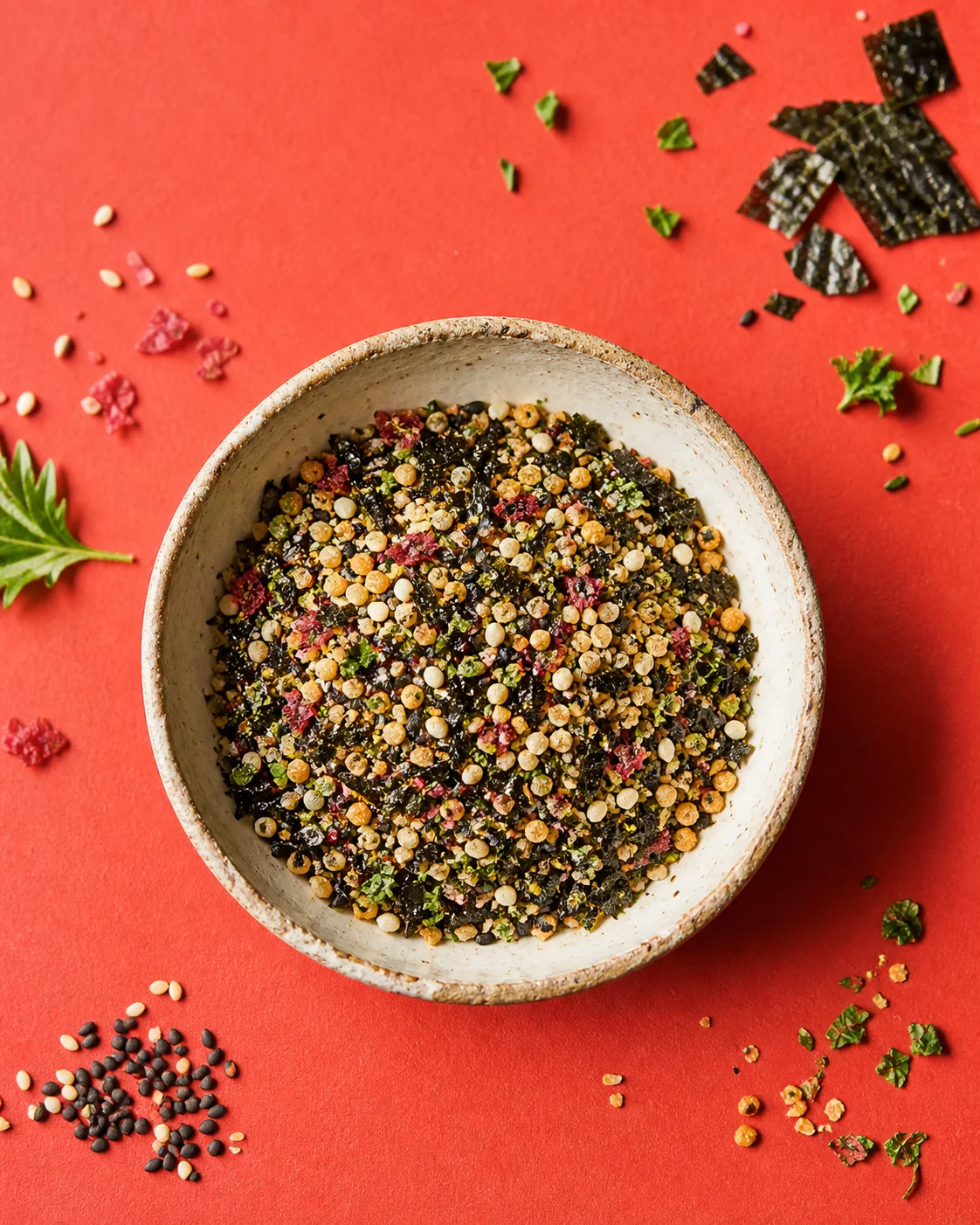
To read a Japanese furikake label in the store, find five headings: 原材料名 (ingredients), 内容量 (net weight), 賞味期限 (best-before), 保存方法 (storage), and the allergen wording (一部に〇〇を含む) (“contains…”). Read the full ingredient statement, not only the allergen line: fish as a broad category is not one of Japan’s mandatory or recommended allergen names.
Not sure whether the packet is furikake at all? Use the 10-second furikake, ochazuke, and togarashi packet check first, then return here for the ingredients and directions.
If the front names an unfamiliar ingredient such as かつお, しそ, 梅, or たらこ, use the furikake flavor and Japanese packet-word guide to identify the direction. Then return to the full ingredient statement; the flavor word alone does not establish allergens or dietary suitability.
A Typical Information Panel, Line by Line
| What you see | Reading | What to do with it |
|---|---|---|
| 名称 | meishō | Product category/name |
| 原材料名 | genzairyō-mei | Read the complete ingredient statement |
| 添加物 | tenkabutsu | Additives, if shown in a separate row |
| 内容量 | naiyōryō | Net weight; look for g and the number of 小袋 (inner packets) |
| 賞味期限 | shōmi kigen | Best-before for the unopened product stored as directed |
| 消費期限 | shōhi kigen | Use-by; do not eat after this date |
| 保存方法 | hozon hōhō | Storage method |
| 製造者 / 販売者 | seizōsha / hanbaisha | Manufacturer / seller |
The exact layout changes by maker. Additives may have their own row, or may follow a slash (/) or a clear line break inside the ingredients row. The Consumer Affairs Agency’s additive guide documents these as standard ways of separating additives from ingredients. Do not read the slash as “everything after this is optional information”; it marks a regulatory display boundary, not a safety boundary.
One especially common additive phrase is 調味料(アミノ酸) or 調味料(アミノ酸等). It is a collective seasoning name, not an individual substance name, so the wording alone does not identify exact MSG. Read Does Furikake Have MSG? for the live database count, category definitions, and label-only limit.
How the Allergen Statement Appears
Japanese packages can identify an allergen beside an individual ingredient, such as マヨネーズ(卵・大豆を含む), or use a combined statement near the end: (一部に卵・乳成分・小麦を含む). The Consumer Affairs Agency says individual display is the principle, while a combined statement may be used in allowed cases. That is why searching only the final few characters can miss relevant information.
Useful terms on furikake include:
| Japanese | English |
|---|---|
| 卵 | egg |
| 乳成分 | milk component |
| 小麦 | wheat |
| えび / かに | shrimp / crab |
| ごま | sesame |
| 大豆 | soy |
| さけ / さば | salmon / mackerel |
| 鶏肉 / 豚肉 / 牛肉 | chicken / pork / beef |
| ゼラチン | gelatin |
| いか / いくら | squid / salmon roe |
For furikake, also scan the ingredients for fish words that do not reduce to one allergen chip: かつお節 (dried bonito flakes), 魚粉 (fish powder), 煮干 (dried small fish), 魚介エキス (seafood extract), and まだらこ (cod roe; madarako). Our no-fish guide uses the complete ingredient statement for exactly this reason.
Japan Has 9 Mandatory Allergens as of April 2026
The current mandatory set for packaged processed food is:
Egg, milk, wheat, buckwheat, peanut, shrimp, crab, walnut, and cashew.
Cashew moved from recommended to mandatory labeling on April 1, 2026. Under the transition provisions, general-use processed food manufactured, processed, or imported by March 31, 2028 can still use the former rule; business-use food sold by that date has a corresponding transition. Stock labeled under those provisions can remain in circulation afterward, so a shopper cannot use the calendar alone to assume that every packet follows the nine-item format. The same 2026 update added pistachio to the recommended, voluntary list.
Japan also recommends labeling 20 more items: almond, abalone, squid, salmon roe, orange, kiwi, beef, sesame, salmon, mackerel, soy, chicken, banana, pistachio, pork, macadamia nut, peach, yam, apple, and gelatin. “Recommended” is not the same as required. A missing voluntary name is not proof that the ingredient or cross-contact risk is absent.
Fish, Sesame, and Soy Need Extra Care
Fish itself is not a single item on either Japanese allergen list. Salmon and mackerel are recommended names, but bonito, sardine, tuna, and pollock can appear as ordinary ingredients. That is a major difference between “I do not see a mandatory fish warning” and “this product contains no fish ingredient.”
Sesame (ごま) and soy (大豆) are recommended rather than mandatory in Japan. They are common in furikake, so check both the ingredient body and any allergen statement. Our allergen chart compares all 9 mandatory items plus high-relevance voluntary and ingredient checks across the 28 products we have verified.
How to Read the Date and Storage Lines
賞味期限 is a best-before date: the period in which the unopened food should maintain expected quality when stored as directed. 消費期限 is a use-by date and should not be treated the same way. Wording such as 枠外下部に記載 means the date is printed below or outside the information box, often on a seal.
Common storage language:
- 直射日光を避けて保存 — store away from direct sunlight
- 高温多湿を避けて保存 — avoid high temperature and humidity
- 常温で保存 — store at room temperature
- 要冷蔵 — keep refrigerated
- 開封後はお早めに — use promptly after opening
The exact package instruction wins, especially for soft furikake. Our furikake storage guide explains why the printed date assumes an unopened package.
A Store-Shelf Decision Order That Works
- Restriction first. If the recipient has an allergy or dietary restriction, rule out ingredients before comparing flavor.
- Read the exact SKU. One brand or series can contain several different formulas.
- Check the date and storage. Make sure the packet suits the rest of the trip and the gifting date.
- Confirm the package format. Count 小袋 if you want individual servings; check 内容量 for total grams.
- Keep evidence. Photograph the ingredient panel before discarding the outer package, particularly when inner packets do not repeat the full label.
That last step is mundane but useful. A handful of unlabeled mini packets in a suitcase are much harder to identify later than the outer box they came in.
The 5-Photo Furikake Passport
Before you leave the store—or before you discard the outer package—take five photos that preserve different parts of the product record:
- Front of pack: product name, flavor, and series.
- Full back panel: the complete ingredients, allergen statement, and responsible company.
- JAN/barcode close-up: a searchable identifier for finding the same SKU again.
- Best-before and storage: the printed date plus the exact handling instructions.
- Shelf label or receipt: store, branch, sighting date, and price at that time.
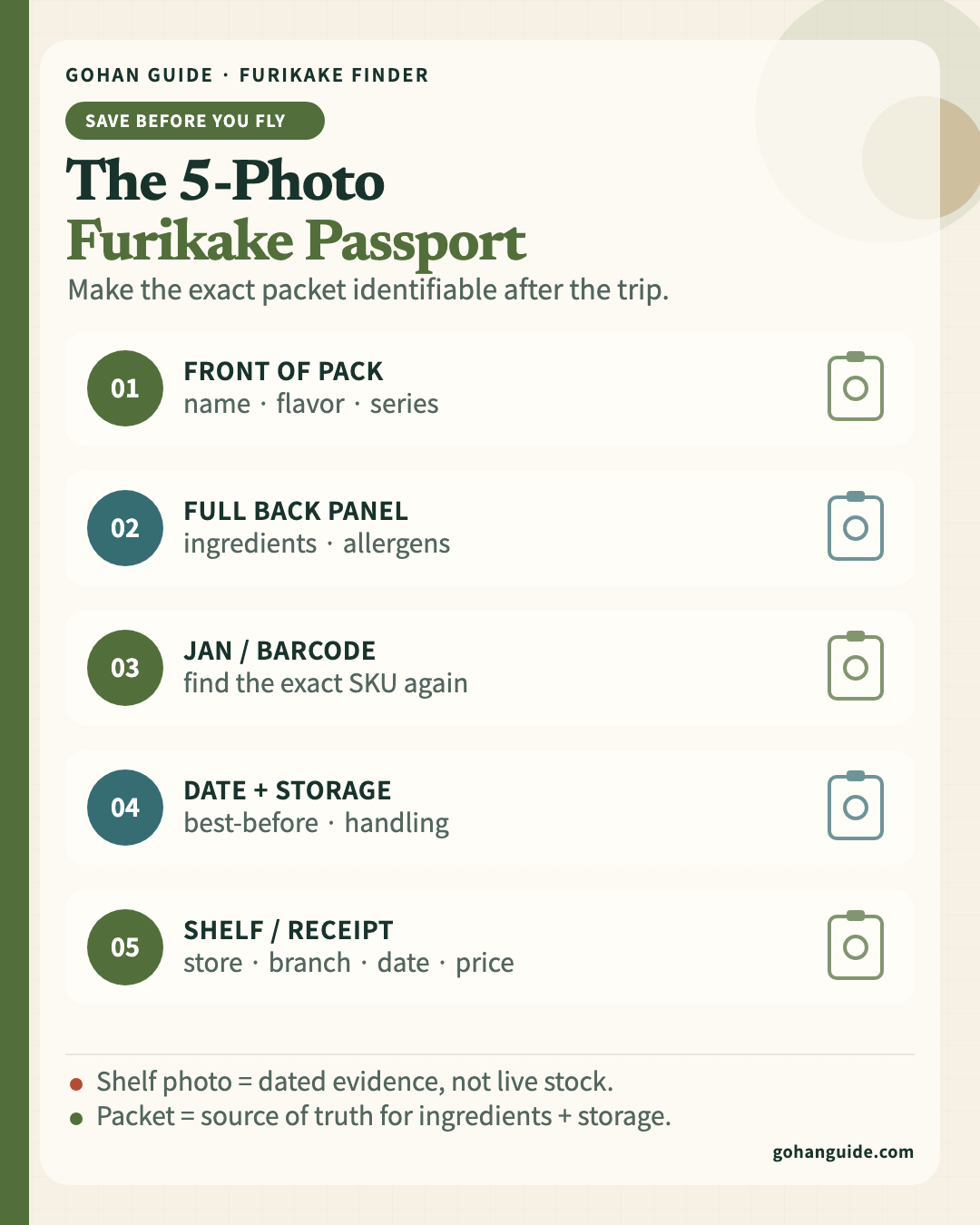
Save the 4:5 card before shopping, then keep the five photos together until the packet is finished.
Common Questions
Does a Japanese furikake label list every allergen?
No. Nine allergens are mandatory as of April 1, 2026, with transition rules that allow qualifying food made, imported, or sold by March 31, 2028 to use the former rule. Twenty more are recommended, not required, and fish as a broad category is not on either list. Read the full ingredient statement and the manufacturer’s cross-contact notice.
What does “一部に” mean on an ingredient label?
In the phrase (一部に〇〇を含む), it introduces the allergen names included in the product’s combined allergen statement. A natural English rendering is “contains: …”. It does not mean the listed allergen is present only in a harmless amount.
Can Google Translate or camera translation clear a product for an allergy?
It can help you locate 原材料名, 賞味期限, and familiar ingredient terms. It can also mistranslate compact legal wording, skip small print, or lose the relationship between an ingredient and a parenthetical allergen. For a serious allergy, use the physical label and manufacturer information with qualified medical advice; Gohan Guide is not a medical safety certification.
Where can I compare furikake label facts?
Start with our product database. Each page keeps the Japanese ingredient text, normalized ingredient and allergen facts, the official source, and the date we checked it. An English ingredient translation appears only after a separate source review; until then, the page says it has not been published. Read how we verify the data before relying on the normalized facts.
Once you can decode the packet, use the brand guide or souvenir shortlist to narrow the shelf without replacing the final label check.
Sources & methodology
Method: Claims on this page are checked against the named official or primary sources below, using the limitations described in Gohan Guide's verification method.
- Japan Consumer Affairs Agency — Food Allergen Labeling Portal
- Japan Consumer Affairs Agency — Overview of Food Allergen Labeling (PDF)
- Japan Consumer Affairs Agency — Processed-Food Allergen Labeling Handbook (PDF)
- Japan Consumer Affairs Agency — Cashew Mandatory-Label Transition Notice (PDF)
- Japan Consumer Affairs Agency — Food Additive Labeling Guide (PDF)
- Japan Consumer Affairs Agency — Food Past Its Best-Before Date in Emergency Stockpiles