Furikake field guide
Does Furikake Expire? How to Read the Date and Store It
Furikake usually carries a Japanese best-before date, but opening changes the rule. Learn where to find the date, how to store dry and soft types, and when not to guess.
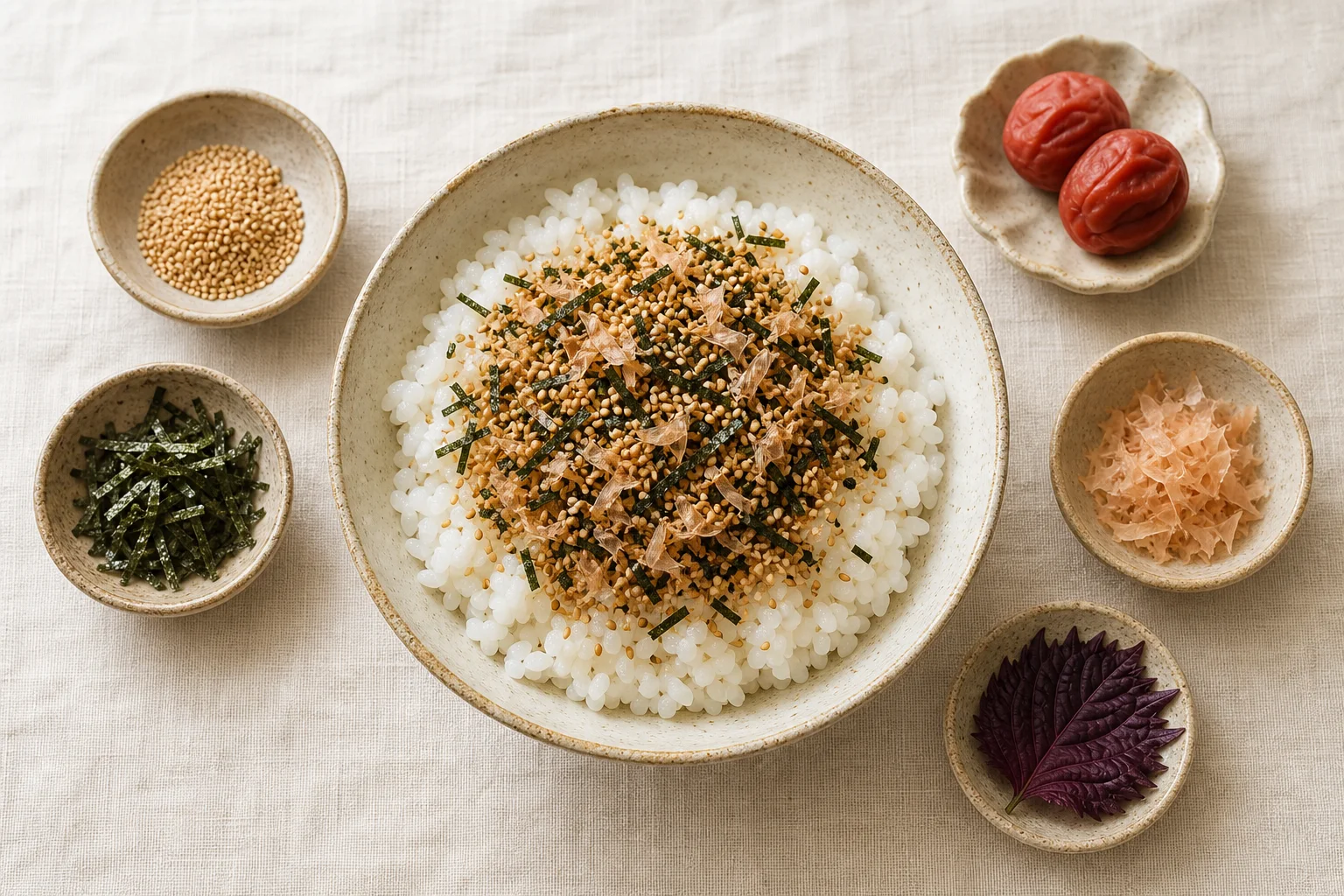
Most unopened, shelf-stable furikake is marked with a best-before date, not one universal “expiration” period. On a Japanese packet, look for 賞味期限 (shōmi kigen), then follow the printed 保存方法 (storage instructions). Once the inner bag is open, the printed date is no longer the whole answer: seal it against moisture, keep it away from heat and direct sun, and use it promptly. Soft furikake and homemade mixtures need their own instructions.
What the Japanese Date Actually Means
| Japanese | Reading | Practical meaning |
|---|---|---|
| 賞味期限 | shōmi kigen | Best-before: the period in which the unopened food should retain its expected quality when stored as directed |
| 消費期限 | shōhi kigen | Use-by: a date after which the product should not be eaten |
| 保存方法 | hozon hōhō | Storage method |
| 開封後 | kaihū-go | After opening |
| お早めにお召し上がりください | ohayame ni omeshiagari kudasai | Consume promptly |
The Consumer Affairs Agency says a best-before date is not the moment food automatically becomes inedible. It also stresses that the date assumes the food is unopened and stored as directed; after opening, use it promptly regardless of the printed date. Nagatanien gives the same practical answer for its products: quality declines after the best-before date, so it recommends eating within the date rather than treating the date as a safety experiment.
If a package says 消費期限, do not substitute the looser best-before logic. Treat it as a use-by date and follow it.
How Long Does Unopened Furikake Last?
As long as the exact manufacturer states for that exact packet. In one official example, Tanaka Foods lists a 12-month best-before period from manufacture for several dry zipper-bag furikake. That is evidence for those products, not a rule for every brand.
Package construction and formula change the answer. A dry, sealed mini packet; a large zipper pouch opened repeatedly; and a soft, moisture-rich furikake are not interchangeable. A date printed as a manufacturer code may also be placed somewhere other than the main label panel. Look for wording such as 賞味期限 枠外下部に記載—“best-before printed below/outside this box”—and then inspect the seal or bottom edge.
For souvenirs, the easiest strategy is not to hunt for the longest theoretical life. Pick a package whose printed date comfortably covers the flight and gifting date, and keep individual inner packets unopened.
How to Store Dry Furikake After Opening
Nagatanien’s current furikake FAQ tells customers to close the zipper firmly, avoid high temperature, humidity, and direct sunlight, and eat the product soon. It recommends refrigerator storage if room temperature is a concern. Tanaka Foods likewise tells customers to close the zipper after opening, consume early, and store away from direct sunlight, heat, and moisture.
That gives a simple order of operations:
- Push excess air out gently without crushing the contents.
- Wipe loose grains away from the zipper track.
- Close the seal from end to end.
- Put the bag in a cool, dry, dark place.
- If the room runs hot, follow the maker’s refrigerator guidance and prevent condensation when taking the bag in and out.
Do not pour a new packet into a container that is damp, holding old crumbs, or still warm from washing. Moisture is exactly what the manufacturers’ instructions tell you to avoid.
Dry, Soft, and Homemade Are Different Products
Dry furikake is the familiar shelf-stable sprinkle. The maker’s date and resealing instructions apply to that packaged product.
Soft furikake contains more moisture. Do not borrow a dry product’s storage rule or shelf life. Read the exact package for refrigeration and after-opening instructions; if the maker says refrigerate, that instruction wins.
Homemade furikake is cooked food, not a commercial sealed product with a validated best-before period. Its safe life depends on ingredients, moisture, preparation, cooling, and storage. We do not assign a blanket number. Use normal food-safety guidance for the most perishable ingredient in the recipe.
When Should You Throw It Out?
A passed 賞味期限 alone does not prove that an unopened food became unsafe at midnight, but a website cannot inspect your packet. Do not eat furikake with a broken seal, moisture inside, visible mold, insects, an unexplained odor, or a package that was stored contrary to its instructions. If the label uses 消費期限, do not eat it after that date.
For an opened packet, the manufacturer instruction to consume promptly is more useful than inventing a precise number of days. When the history is unknown—an unsealed bag from a hotel breakfast bar, a pouch left in a hot car, or a gift with an unreadable date—the sensible answer is not to guess.
Common Questions
Does furikake need to be refrigerated?
Not every unopened dry product does. Follow 保存方法 on the exact package. Nagatanien says a firmly closed zipper bag can be kept away from heat, humidity, and direct sun and recommends refrigeration when room temperature is a concern. Soft products may carry different instructions.
Can I eat furikake after the best-before date?
Japan’s Consumer Affairs Agency distinguishes 賞味期限 (best-before) from 消費期限 (use-by): passing a best-before date does not make an unopened, correctly stored food automatically inedible. But quality may decline, and neither the agency nor Gohan Guide can judge your packet remotely. If you are unsure how it was stored, discard it.
Does individually wrapped furikake last longer after I open the box?
An unopened inner packet remains separately sealed even when the outer box is open. Nagatanien’s FAQ explicitly distinguishes opening the outer package from opening the inner packet for products that tell you to use a serving after opening. The date still depends on storing the box as directed.
Where is the date on a Japanese furikake packet?
Find 賞味期限 or 消費期限 in the information panel. If the line points elsewhere with wording such as 枠外下部に記載, inspect the bottom seal or another outer edge. Our Japanese furikake label decoder covers the rest of that panel.
If you are choosing a travel-friendly format, compare our souvenir shortlist and brand guide. For customs rules on the trip home, storage and border permission are separate questions—use the customs guide.
Sources & methodology
Method: Claims on this page are checked against the named official or primary sources below, using the limitations described in Gohan Guide's verification method.