Furikake field guide
Does Furikake Have MSG? How to Read the Japanese Label
Many furikake labels use seasoning (amino acids), but that group name does not identify exact MSG. Learn what the Japanese wording proves—and what it does not.
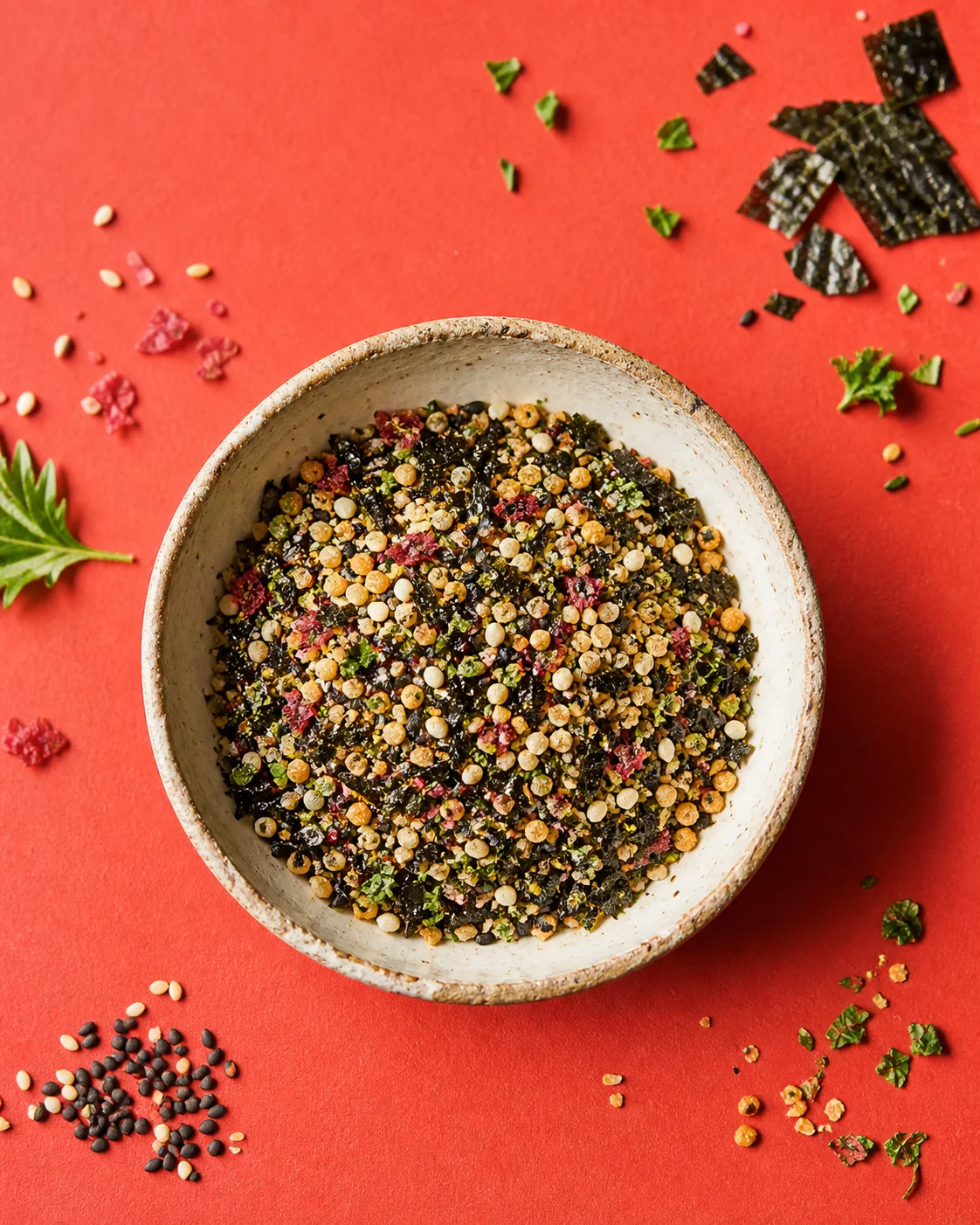
Furikake often carries a Japanese additive label translated as “seasoning (amino acids)”. In our current database, 27 of 28 official-source product records show 調味料(アミノ酸) or 調味料(アミノ酸等) in the published Japanese ingredient text. That makes the wording common; it does not prove that every one of those products contains the exact additive monosodium glutamate (MSG).
The reason is simple: this is a regulatory group name, not an individual substance name. Japan’s Consumer Affairs Agency includes L-glutamic acid monosodium salt—the additive commonly called MSG—within the amino-acid seasoning group, but the same group contains other permitted amino acids. The packet may therefore establish the group and purpose while leaving the exact substance undisclosed.
What the Two Common Labels Mean
Japan’s food-additive rules allow certain flavoring additives to be displayed under a collective seasoning name. The Consumer Affairs Agency groups them into four families: amino acids, nucleic acids, organic acids, and inorganic salts.
This distinction is easy to lose in translation. A camera app may render 調味料(アミノ酸等) as “amino acid seasoning,” “seasoning (amino acids, etc.),” or simply “flavor enhancer.” All point to a seasoning-additive category. None supplies the missing formulation.
| Japanese label | What it establishes | What it does not establish |
|---|---|---|
| 調味料(アミノ酸) | The seasoning is composed of the amino-acid group | Which amino acid or amino acids were used |
| 調味料(アミノ酸等) | Amino acids are the representative, larger group in a seasoning blend that also draws from another seasoning group | The individual substances or their amounts |
| L-グルタミン酸ナトリウム | Monosodium L-glutamate is named individually | Why it was chosen or how much the finished food contains |
The 等 (tō, “etc.”) matters, but not in the way a quick translation can suggest. It indicates that the seasoning preparation is not made only from the named representative group. The agency’s current allergen-labeling handbook explains that the largest of the four seasoning groups is used as the representative in 調味料(〇〇等). It is not a shorthand for “MSG plus unspecified ingredients.”
Why “Amino Acids” Is Broader Than MSG
The Consumer Affairs Agency’s detailed additive notice lists multiple substances within the amino-acid seasoning range. L-glutamic acid monosodium salt is on that list, alongside substances such as glycine, DL-alanine, L-aspartic acid sodium salt, and others. Because the permitted group is broader than one member, seeing the group name cannot tell a shopper which member was used.
The agency’s consumer guide uses L-glutamic acid monosodium salt as an example of a seasoning additive. An example shows that MSG belongs to the category; it does not make MSG the automatic meaning of every category label.
That is why we use the phrase “amino-acid seasoning group name” in our own database reporting. It stays close to the evidence printed on the maker’s label.
What We Found Across 28 Product Records
As of 2026-07-13, 27 of the 28 products we have verified (96%) print one of the two amino-acid seasoning group names somewhere in the Japanese ingredient text. This is a count of products, not occurrences: an assortment with the wording in several flavors still counts once.
The remaining record does not show that group name in the official web ingredient text we captured. That is not evidence for a universal “MSG-free” claim. A missing group phrase can reflect a different formula, a different way of listing an additive, or limits in the source record. Our job is to report what the cited source shows, not to infer a formulation the source does not establish.
For the source text behind an individual count, open the product page and read Japanese ingredients together with its official manufacturer link and verification date. The count updates at build time when the product dataset changes.
Three Label Traps to Avoid
1. Translating a category as a chemical
“Seasoning (amino acids)” is a useful English rendering of the category. Replacing it with “MSG” changes a broader regulatory label into one exact substance. That may be correct for a particular formula, but the group wording alone cannot prove it.
2. Treating 酵母エキス as the same label
酵母エキス (yeast extract) and たん白加水分解物 (hydrolyzed protein) can appear in the food-ingredient portion of a furikake label. They are not interchangeable with the additive group name 調味料(アミノ酸等). Keep each printed term separate when comparing products.
3. Reading absence as a verified “free from” claim
Our label screen can say that a phrase is present or not present in the source we reviewed. It cannot certify a negative formulation claim, test the finished food, or speak for another size, flavor, market, or reformulated packet. When the exact substance is important, use the maker contact printed on the package and identify the product by name and JAN code.
How to Check a Packet in the Store
- Find 原材料名 (ingredients).
- Look after the slash / or in a separate 添加物 row, where additives are commonly separated from food ingredients.
- Scan for 調味料(アミノ酸) and 調味料(アミノ酸等). Also accept half-width parentheses on a web listing: 調味料(アミノ酸等).
- Do not stop at the translated group name if you need the exact additive.
- Photograph the full panel and contact the maker for product-specific confirmation.
Our Japanese furikake label decoder explains the rest of the panel, including the slash, allergen statement, date, and storage line.
Common Questions
Is 調味料(アミノ酸等) the Japanese word for MSG?
No. It is a collective seasoning label led by the amino-acid group. MSG is one permitted member of that group, but the phrase does not identify the individual additives used in the product.
Does 調味料(アミノ酸) prove there is no MSG because it lacks 等?
No. Without 等, the seasoning falls within the amino-acid group alone; the exact amino acid or combination is still not named by that collective wording.
Can I use this guide to find “no MSG” furikake?
It can help you identify the Japanese group wording and avoid mistranslating it. It cannot turn absence of that wording into a certified “no MSG” claim. Check the current physical packet and ask the manufacturer to confirm the exact product formulation.
Why not publish a list of MSG-free products?
Because the available official-source ingredient records do not support that conclusion consistently. We can publish the evidence we have—group wording, recorded Japanese ingredient text, source URL, confidence note, and check date—without pretending it answers a more specific question.
Start with the full product database to inspect an exact packet, or use the dietary guidance hub for other label-based checks and their limits.
Sources & methodology
Method: Claims on this page are checked against the named official or primary sources below, using the limitations described in Gohan Guide's verification method.