Furikake field guide
Can You Bring Furikake Home From Japan? Customs & Packing Guide
Can you pack furikake from Japan? Check current US, Australian, Canadian, and British customs guidance, plus ingredients and packing tips.
Short answer: you can often bring commercially packaged furikake home from Japan, but the answer depends on what is in the packet and where you are landing. Fish, meat, dairy, egg, seeds, and plant material do not all follow the same border rules. Keep the original package, check the ingredients, and declare food when your destination requires it. The border officer—not this guide—makes the final decision.
This page covers food carried in your personal luggage, not food shipped by post or imported for sale. Rules can change quickly after an animal-disease or biosecurity alert. The destination-authority links below were checked on July 13, 2026, and the Japan tax-free source was checked on July 14, 2026; open the relevant authority’s page again before you fly.
Check the Packet, Not Just the Word “Furikake”
Furikake is a category, not one fixed recipe. A plain-looking seaweed packet may include dried bonito, mackerel, shrimp, egg, milk powder, chicken extract, or beef fat. In our current database, even familiar products can cross several customs categories:
- Noritama lists fish, egg, dairy, and meat-derived ingredients.
- Sukiyaki Furikake contains meat-derived ingredients.
- Yukari has no fish, shellfish, meat, egg, or dairy ingredient listed, but it is not a customs guarantee or a certified vegan claim.
Use our allergen chart to identify the likely category, then inspect the physical package in case the formula has changed.
Rules by Destination
On a narrow screen, swipe the table to compare all columns.
| Destination | What the official guidance says | Practical next step |
|---|---|---|
| United States | USDA APHIS says travellers entering the country must declare all agricultural or wildlife products and that inspectors make the final entry decision. CBP says most personal quantities of seafood are admissible, with exceptions, but a mixed furikake may contain more than seafood. | Declare every packet. Keep it commercially packaged and be ready to show the ingredient list. Check meat or poultry ingredients separately. |
| Australia | Australian authorities require travellers to declare food, plant material, and animal items that may present a biosecurity risk. A biosecurity officer may inspect the product, and the BICON database holds product-specific conditions. | Declare rather than guess. Search BICON using the ingredients and Japan as the origin country before departure. |
| Canada | Canada requires travellers to declare all food, plant, and animal products. Admissibility can depend on the product, origin country, and province of entry. | Declare every packet and check Canada’s Automated Import Reference System for the relevant ingredients. |
| Great Britain | The government’s overview lists packaged flavourings among foods that can be brought from any country, while its animal-products page says meat and milk products from outside the EU are not allowed and permits up to 20kg of fish products. Neither page classifies a mixed seasoning such as furikake. | Read both official pages. If the packet contains meat or dairy, ask the authority before travel or leave it behind rather than assuming the “flavourings” exception applies. |
Official sources: current US food guidance, US seafood guidance, USDA traveller guidance, Australian declaration guidance, Australia’s detailed biosecurity guidance, Australia’s BICON tool, Canadian traveller guidance, Canada’s AIRS reference tool, the Great Britain food overview, and its rules for meat, dairy, fish, and animal products.
A Note About the United Kingdom
The table describes Great Britain—England, Scotland, and Wales. The two official Great Britain pages above do not resolve how a multi-ingredient furikake is classified when a generally permitted packaged flavouring also contains a restricted animal ingredient. Do not treat this article as a clearance decision; ask the border authority about the exact ingredient list. Northern Ireland has different rules, so use the destination-specific link from the UK government’s main food guidance if that is where you are arriving.
A Five-Minute Pre-Flight Check
- Read the exact packet. Start with our source-linked product page for the Japanese ingredient statement and normalized label facts, then check the physical label. Pay particular attention to fish, meat, poultry, dairy, egg, shellfish, sesame, and seeds.
- Open the destination guide. Search the official tool for each animal-derived ingredient, not just “rice seasoning.” A rule written for dried fish or meat products may be more relevant than one written for spices.
- Keep the retail packaging. USDA recommends receipts and original packaging as proof of origin for agricultural products. The Japanese name, maker, sealed condition, and ingredient panel give an officer more to work with than an unlabelled zip bag.
- Pack food together. Put the packets in one clear, resealable outer bag. This contains spills and makes inspection simpler.
- Follow declaration instructions. Use the current instructions for your destination. Declaration does not guarantee admission, and the destination authority makes the final decision.
If a product contains an ingredient your destination bans, leaving it sealed does not override the ban. “Dry,” “processed,” and “only a small amount” are not universal exemptions.
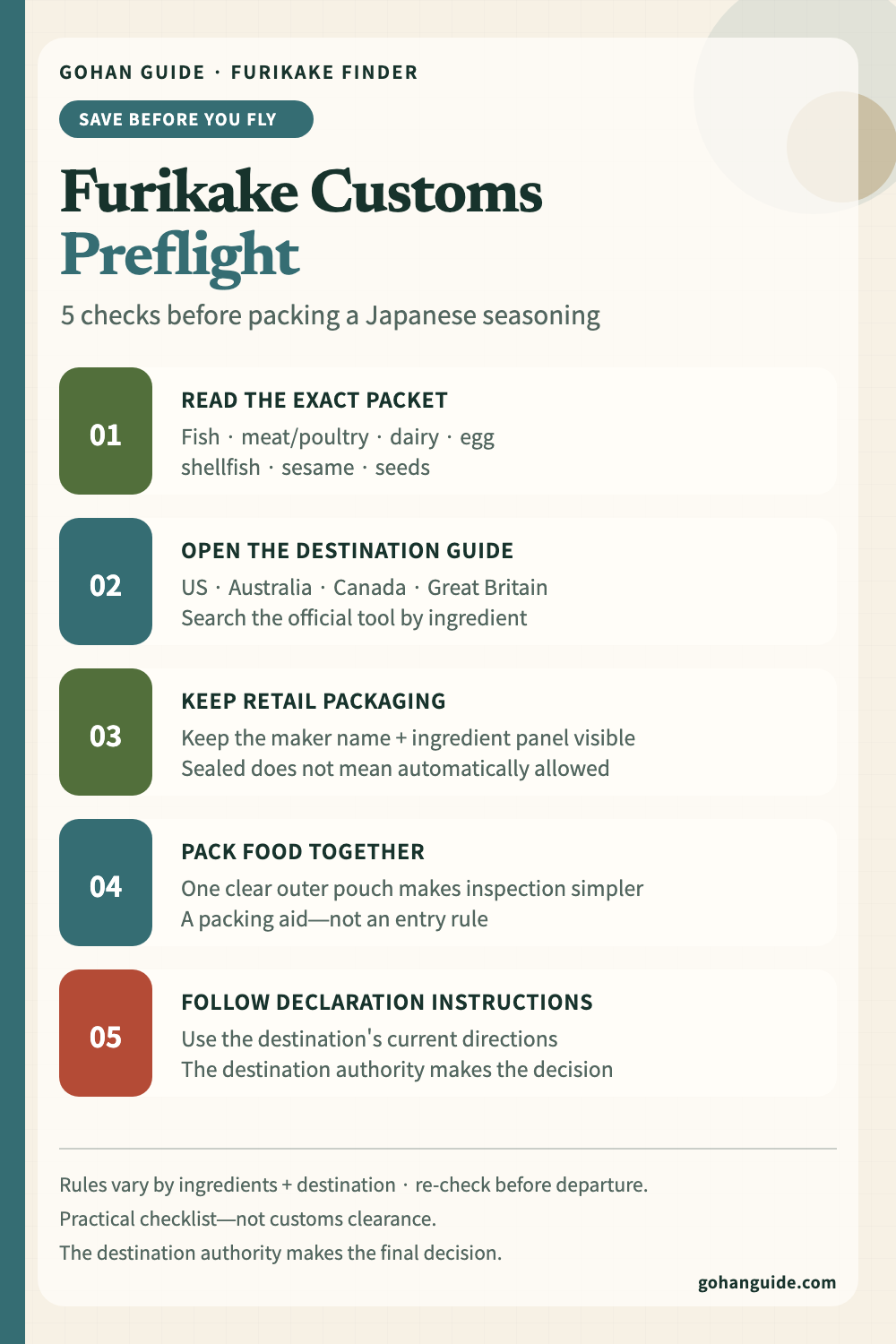
Save the 2:3 card before packing, then re-check the destination authority’s current instructions for the exact ingredients.
Japan’s Tax-Free Exit Check Is a Separate Step
Buying food tax-free in Japan does not decide whether the destination will admit it. For purchases made from November 1, 2026, the Japan Tourism Agency’s traveler guidance says eligible shoppers pay the tax-inclusive price first, then complete Japan’s departure customs procedure within 90 days so the shop or its provider can issue the refund.
Complete that procedure before checking luggage and keep every tax-free item from the transaction with you. Japan’s guidance says a consumed or missing item can prevent that transaction from qualifying for the customs confirmation and refund. Afterward, the rules of the country where you land still control import and declaration. See the purchase-date comparison in the where-to-buy guide for the system through October 31 and the new process from November 1.
Which Packages Travel Best?
The border rules concern ingredients; suitcase survival is a separate problem. Our 28-product database includes three useful formats:
- Individually wrapped multi-packs: Nagatanien’s Otona no Furikake line separates servings into small packets. If one tears, the rest stay sealed. The Pokémon and Anpanman assortments use 20 mini packets.
- Resealable stand-up pouches: Sarukani Gassen comes in a 110g moisture-resistant pouch; Kyo Rayu is an 80g zipper pouch whose label lists egg and wheat. A sturdy format does not change the destination’s ingredient rules.
- Standard refill bags: These are light and easy to tuck into a suitcase, but use a rigid pouch or wrap them between clothes. A pinhole can season an entire suitcase.
Shelf Life After the Flight
Most dry furikake is shelf-stable for months while unopened, but there is no single shelf life for the category. Read the 賞味期限 (shōmi kigen, best-before date) on the package. Once opened, humidity is the main nuisance: the flakes lose aroma, soften, and clump. Press out excess air, reseal the bag, and store it in the cool, dry place specified by the maker.
Semi-moist nama-furikake deserves extra attention. Ika Konbu is sold as shelf-stable, but that does not mean every soft furikake has identical storage instructions. Follow the individual package.
Common Questions
Do I need to declare furikake in the United States?
Declare it. USDA APHIS says travellers entering the United States must declare all agricultural or wildlife products, and its inspectors make the final entry decision. Most personal quantities of seafood are generally admissible, but furikake can also contain meat, poultry, dairy, or other regulated ingredients. Show the exact packet and let the inspecting officer decide.
Can I bring furikake into Australia?
Do not assume a dry, sealed packet is automatically allowed. Australian biosecurity rules depend on the ingredients and origin. Check BICON before travel and declare the product on arrival when required; declared goods can be inspected by a biosecurity officer.
Should furikake go in carry-on or checked luggage?
Destination customs and biosecurity rules apply regardless of which bag holds it. Dry packets are usually simpler to pack than liquids, but airport-security screening is separate from customs and may apply extra rules to powders or semi-moist products. Keep the original packaging, place packets in a sealed outer pouch, and check the departure airport and airline guidance before choosing carry-on or checked luggage. If the purchase uses Japan’s tax-free system from November 1, 2026, complete its departure procedure before checking the bag, as explained above.
Is fish-free furikake automatically safe to bring home?
No. Fish-free products may still contain meat, dairy, egg, seeds, or plant ingredients covered by a destination’s rules. “No fish listed” is one useful filter, not a customs clearance. See our no-fish list and check every other ingredient too.
Next, compare our best furikake souvenir picks or see where furikake is generally sold in Japan.
Sources & methodology
Method: Claims on this page are checked against the named official or primary sources below, using the limitations described in Gohan Guide's verification method.
- Japan Tourism Agency — Tax-Free Refund Method for Travelers from November 1, 2026
- US Customs and Border Protection — Food Items Entering the United States
- US Customs and Border Protection — Personal-Use Seafood Guidance
- USDA APHIS — International Traveler: Souvenirs
- Australian Border Force — Declare It: Food, Plant and Animal Items
- Australian Department of Agriculture — Bringing or Mailing Goods into Australia
- Australian Government — BICON Import Conditions Database
- Canada Border Services Agency — Bringing Food, Plant and Animal Products into Canada
- Canadian Food Inspection Agency — Automated Import Reference System
- GOV.UK — Bringing Food into Great Britain
- GOV.UK — Meat, Dairy, Fish and Animal Products
- Ochanokosaisai — Kyo Rayu Furikake (Japanese Product Page)