Furikake field guide
Otona no Furikake Flavors: Mini Packs Compared
A current, official-source guide to Nagatanien's Otona no Furikake flavors, Mini assortments, ingredients, pack sizes, and what the adult name means.
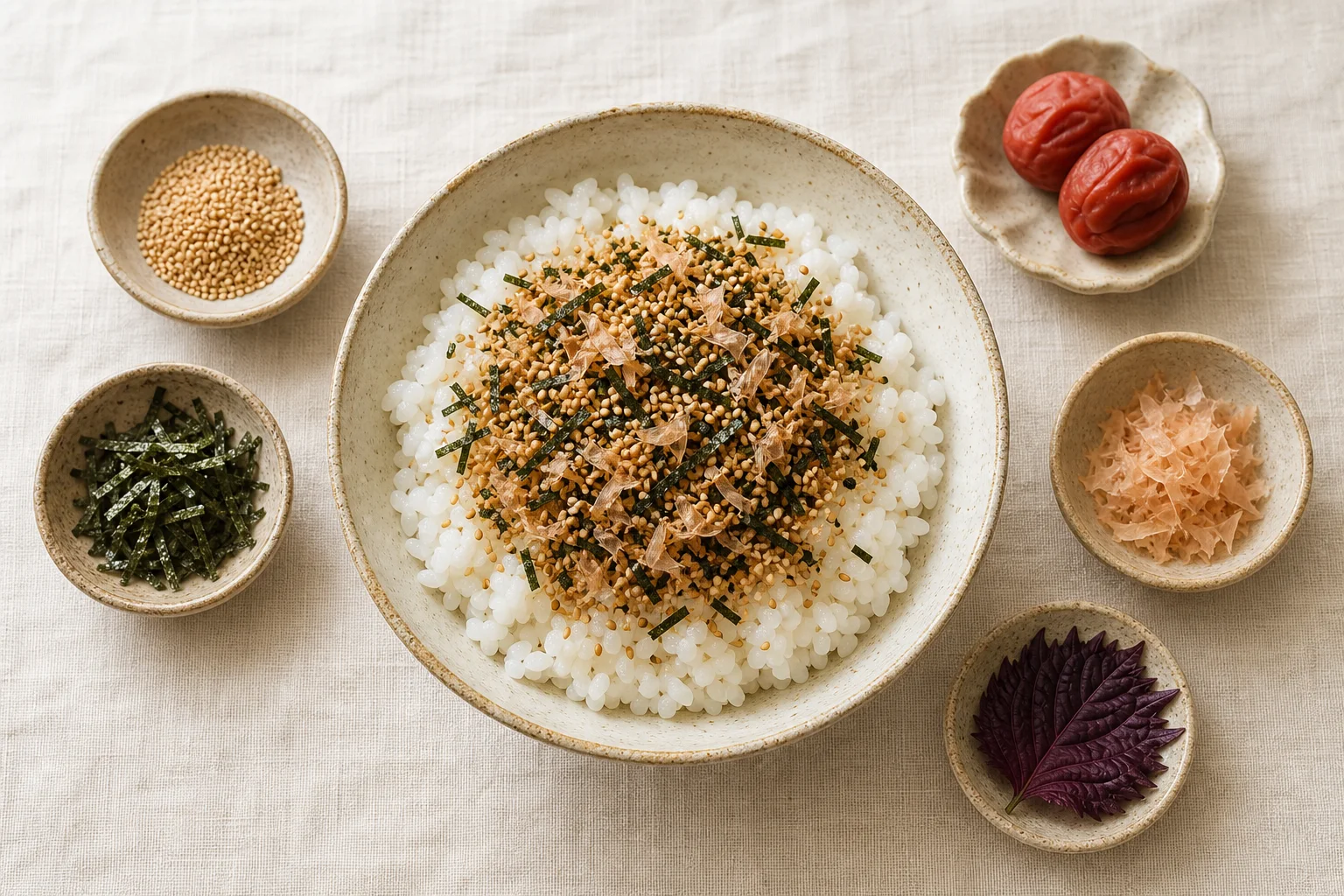
Otona no Furikake is Nagatanien’s “furikake for adults,” but it is not age-restricted. The company created the line to challenge the idea that furikake was children’s food. Its current Japanese range has six standard flavors in four-packet packs, plus three different 20-packet Mini assortments. This guide uses Nagatanien’s own descriptions and labels; we have not taste-tested or ranked the flavors.
What Does “Otona no Furikake” Mean?
Otona (おとな) means “adult,” so the name reads roughly as “furikake for adults.” It describes the line’s positioning, not a rule about who may eat it. Nagatanien’s English history says the project began after its market data showed furikake use dropping sharply after childhood. The team wanted to undo the assumption that furikake belonged only in children’s meals.
The first three flavors—bonito, salmon, and wasabi—went on sale in selected regions in October 1989. Nagatanien expanded them nationwide in February 1990. Those three are still present in the Japanese standard range, now joined by Beef Shigure, Spicy Cod Roe, and Ume Shiso.
The 6 Standard Flavors, Compared by Label
All six standard Japanese packs contain four small sachets and carry a ¥140 pre-tax manufacturer reference price in Nagatanien’s September 2025 range announcement. That is not a promise about the price or stock in a particular shop. The pack weights differ because the amount in one sachet differs by recipe.
| Japanese pack | Useful reading of the label | Official description points | Japanese pack size |
|---|---|---|---|
| 牛しぐれ — Beef Shigure | Beef flakes, beef oil, ginger, nori; the contains statement includes wheat, milk, beef, sesame, soy, and pork | Sweet-salty beef with ginger | 12.8g / 4 |
| 本かつお — Bonito | Bonito powder and flakes, nori, sesame; wheat, sesame, and soy are listed allergens | Sweet-salty seasoned bonito with crisp nori | 9.2g / 4 |
| 紅鮭 — Sockeye Salmon | Lactose, salmon powder, salmon extract and flakes, nori, soy | Sockeye salmon with crisp nori | 8.4g / 4 |
| わさび — Wasabi | Wasabi powder and stem, bonito, nori, sesame; wheat, sesame, and soy are listed allergens | Fresh-wasabi-like aroma and a sharp wasabi direction with bonito and nori | 8.4g / 4 |
| 辛子明太子 — Spicy Cod Roe | Lactose, wheat flour, chile, fish sauce, seafood extract, and cod-roe powder | Direct chile heat with a fish-sauce-led savory direction | 6.8g / 4 |
| 梅しそ — Ume Shiso | Seasoned shiso leaf, ume, bonito, and nori; wheat and soy are listed allergens | Shiso aroma with moderate acidity | 6.8g / 4 |
This table is a shopping decoder, not a complete allergy screen. “Fish” is not one catch-all allergen name in Japan’s 28-item display, and bonito appears in products whose parenthetical allergen statement does not literally say “fish.” Nagatanien also warns that a website can lag a package revision. For an allergy, read the product in your hand and use the maker’s linked page as supporting—not substitute—evidence. Our Japanese furikake label guide explains where to look.
Otona no Furikake Mini 1 vs. Mini 2 vs. Seishun-hen
The Mini boxes are not sampler boxes containing all six standard flavors. Each has 20 single-serving packets, but the menus are different.
| Mini assortment | What is inside | Packet split | Best fit based on format, not taste |
|---|---|---|---|
| Mini Sono 1 | Bonito, salmon, wasabi, grilled cod roe, nori-and-egg | 5 flavors × 4 | The closest Mini box to the original 1989 trio |
| Mini Sono 2 | Salmon-wakame, ume-yukari, nori-salt, okaka-kombu, chicken-and-egg soboro, mentaiko | 4, 4, 2, 2, 4, 4 | Six rice-seasoning styles in one box |
| Mini Seishun-hen | Gyudon-style, Korean-nori-style, pork-ginger-style, spicy-fried-chicken flavor, keema-curry flavor | 5 flavors × 4 | Meal-inspired flavors rather than the standard line |
“Sono 1” and “Sono 2” simply distinguish the two assortments. Seishun-hen (青春編) means “youth edition.” The name does not make it a fourth standard pack: Nagatanien lists it alongside the other Mini assortments.
A Japanese Pack and an Export Pack May Not Match
Check the market and packet, not only the English product name. Nagatanien’s Japanese Bonito page currently shows four 2.3g sachets and a Japanese ingredient statement. Its English global listing shows a five-serving, 2.4g-per-packet Bonito product with a different ingredient and allergen statement, including milk.
That is a practical warning for travelers who later reorder overseas: a familiar front-of-pack name does not prove that the domestic and export formulas, serving counts, or allergen declarations are identical. Keep a photo of the full label—or the JAN code—if you want the same version again.
Current Safety Notice: One Sockeye Salmon Lot
Checked July 13, 2026: Nagatanien’s January 2, 2026 recall applies to one identified lot of Otona no Furikake Sockeye Salmon, not to every flavor or every salmon pack. The affected outer package says best-before 2026.10, and the right side of the line below it shows 20A. Some Spicy Cod Roe sachets were placed in Sockeye Salmon outer bags, so wheat could be present without wheat appearing on that outer bag.
Anyone with the named lot—especially anyone with a wheat allergy—should follow the manufacturer’s recall notice, not this summary. The notice gives Japan return and contact instructions. A different date or code is not evidence that every other risk has been ruled out; always read the packet you actually have.
Which Pack Should You Buy?
- Choose a four-packet standard pack when you already know which menu you want and prefer four separate servings of it.
- Choose Mini Sono 1 to try the original bonito-salmon-wasabi trio alongside grilled cod roe and nori-and-egg.
- Choose Mini Sono 2 when variety matters more than matching the standard six.
- Choose Mini Seishun-hen for meal-inspired labels such as gyudon, pork ginger, and keema curry.
- Choose none on this page by allergy alone. The nine products do not share one ingredient or allergen statement, and an export pack may differ from a Japanese pack.
For a broader brand comparison, see our Japanese furikake brands guide. If this is going into a suitcase, continue with our furikake souvenir shortlist and country-rule checklist.
Common Questions
What is the best Otona no Furikake flavor?
We cannot honestly name one. Nagatanien documents each flavor’s intended direction, but that is not a controlled comparison, and we have not tasted all six. Use the ingredient and format differences above to make a shortlist; treat any best-to-worst order without a disclosed tasting method as opinion, not product evidence.
Can children eat Otona no Furikake?
The “adult” wording is brand positioning, not an age restriction. Nagatanien’s own history describes the line as an attempt to make furikake appealing beyond childhood and says it became popular with adults and children. Suitability still depends on the exact flavor’s ingredients, allergens, and the individual child.
Are all Otona no Furikake packs spicy?
No. Wasabi and Spicy Cod Roe are the two standard names that explicitly signal heat, while Beef Shigure, Bonito, Sockeye Salmon, and Ume Shiso are presented around other ingredients. That does not establish a numerical heat scale between products; we have not measured or taste-tested them.
Does every Otona no Furikake flavor contain fish?
Do not infer that from the brand name or the front label. Several standard products clearly list bonito, salmon, fish sauce, seafood extract, or pollock roe, and even the Beef Shigure ingredient statement includes bonito extract. Read each current packet. Our database currently has source-linked Japanese ingredient records and normalized ingredient and allergen facts for Bonito, Sockeye Salmon, and Wasabi.
Sources & methodology
Method: Claims on this page are checked against the named official or primary sources below, using the limitations described in Gohan Guide's verification method.
- Nagatanien Global — Otona no Furikake Brand History
- Nagatanien Global — Export Furikake Product Range
- Nagatanien — Otona no Furikake Japanese Brand Page
- Nagatanien — September 2025 Otona no Furikake Range Announcement
- Nagatanien — Otona no Furikake Bonito
- Nagatanien — Otona no Furikake Sockeye Salmon
- Nagatanien — Otona no Furikake Wasabi
- Nagatanien — Otona no Furikake Ume Shiso
- Nagatanien — Otona no Furikake Spicy Cod Roe
- Nagatanien — Otona no Furikake Beef Shigure
- Nagatanien — Otona no Furikake Mini Sono 1
- Nagatanien — Otona no Furikake Mini Sono 2
- Nagatanien — Otona no Furikake Mini Seishun-hen
- Nagatanien — Sockeye Salmon Lot 20A Recall Notice (January 2026)